Kyoto Walking Tour: 50 Free Video Stops

How to tour Kyoto

Use this free self-guided walking tour of Kyoto on your phone as you walk. There’s no app to download, no sign-up and no guide to tip. Begin at Kinkaku-ji, tap a stop for a short narrated video of what you’re looking at, and follow the map link until you reach Tenryu-ji.
Kyoto is the old capital of Japan. Kinkaku-ji, the Golden Pavilion, stands over the Mirror Pond. Fushimi Inari climbs Mount Inari under thousands of vermilion gates. Arashiyama holds the bamboo grove and the river.
Kiyomizu-dera overlooks the city. Gion is the geisha district. Nijo Castle is the shogun’s palace. The Philosopher’s Path runs beside the canal. Ryoan-ji has the rock garden. The Imperial Palace sits in its park. Tenryu-ji closes the walk in Arashiyama.
On this Kyoto walking tour you start at Kinkaku-ji, move through the temples and gardens, and end at Tenryu-ji.
1. Kyoto walking tour: Kinkaku-ji
Kinkakuji-michi · start here · 45–60 minutes
On this Kyoto walking tour, Kinkaku-ji, the Golden Pavilion, was built as the retirement villa of the shogun Ashikaga Yoshimitsu and became a Zen temple after his death in 1408. Each of its three floors is in a different style: a Heian palace on the ground floor, a samurai house on the first floor and a Chinese Zen hall at the top, crowned with a golden phoenix. The upper two floors are covered in gold leaf. In 1950 a young monk set fire to the pavilion and it burned to the ground; the copy you see was rebuilt in 1955.
It stands over Kyoko-chi, the Mirror Pond, with its small pine-covered islands. The path then climbs the hillside past the Sekka-tei teahouse to the little Fudo-do hall. Kinkaku-ji is part of the UNESCO World Heritage Site of historic Kyoto. One-way path, 500 yen, 09:00–17:00; arrive at opening. Bus 12, 101 or 205 to Kinkakuji-michi from Kyoto Station or Nijo. Walk this order on the Kyoto walking tour. The gate and the Golden Pavilion → three floors, three styles → fire and rebirth → the Mirror Pond and its islands → the hillside path, Sekka-tei and Fudo-do.


2. Fushimi Inari Taisha
From stop 1 · JR Nara Line to Inari Station · 60–120 minutes
Along this Kyoto walking tour, Fushimi Inari Taisha is the head shrine of Inari, the god of rice and business, and of about 30,000 Inari shrines across Japan; its history on Mount Inari goes back to 711. You enter through the great torii and the Romon Gate, given by Toyotomi Hideyoshi in 1589, to the Main Hall, built in 1499. Behind it begin the Senbon Torii, the “thousand gates”: tunnels of vermilion torii, each one given by a company or a family whose name is written on the back.
Stone foxes, Inari’s messengers, guard the paths, many with a key to the rice store in their mouths. The torii paths climb all the way up Mount Inari, 233 metres high; the full loop takes two to three hours. Open 24 hours and free. JR Nara Line to Inari Station, 5 minutes from Kyoto Station. Go at dawn or after dusk to miss the crush. Walk this order on the Kyoto walking tour. The great torii and the Romon Gate → the Main Hall of Inari → Senbon Torii, the thousand gates → the fox messengers → climbing Mount Inari.


3. Arashiyama Bamboo Grove
From stop 2 · JR Sagano Line to Saga-Arashiyama
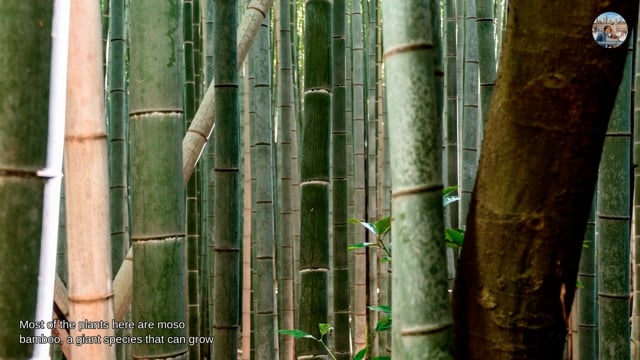
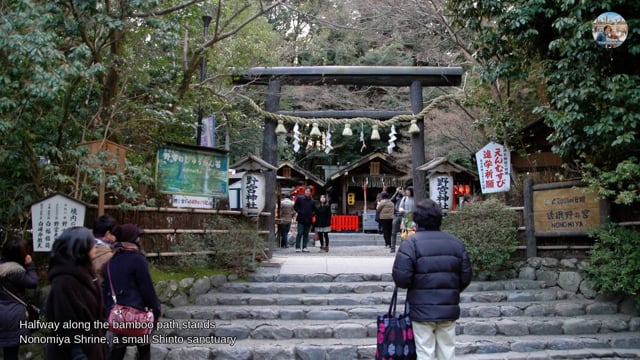
On this Kyoto walking tour, in Arashiyama, on the western edge of Kyoto, a path runs between towering stalks of moso bamboo. The sound of the wind in the Sagano bamboo forest was chosen as one of Japan’s 100 soundscapes, and bamboo from here has long been used for baskets, fences and tea utensils. At the edge of the grove stands Nonomiya Shrine, with its torii of unpainted wood, where imperial princesses purified themselves before serving at the Ise Shrine; it appears in The Tale of Genji.
At the top of the path, Okochi Sanso is the hillside villa and garden of the film star Denjiro Okochi; the ticket includes a cup of matcha. Down by the river, the Togetsukyo Bridge crosses the water where the boat rides down the Hozu River end. The grove is free; arrive before 08:00. JR Sagano Line from Kyoto Station to Saga-Arashiyama, or the Randen tram to Arashiyama. Walk this order on the Kyoto walking tour. The bamboo grove path → the sound and craft of bamboo → Nonomiya Shrine → Okochi Sanso Villa → Togetsukyo and the Hozu River.

4. Kiyomizu-dera
From stop 3 · across town · Sannenzaka · 60–90 minutes
Along this Kyoto walking tour, Kiyomizu-dera was founded in 778 on the slopes of eastern Kyoto, and it is part of the UNESCO World Heritage Site. You climb past the red Nio Gate and the three-storied pagoda to the Main Hall, rebuilt in 1633, whose huge wooden stage juts out over the hillside on a frame of wooden pillars put together without nails. The stage is famous in every season, with cherry blossom in spring, green maples in summer and red leaves in autumn.
Below it, the Otowa Waterfall splits into three streams; visitors catch the water in long-handled cups, each stream said to bring long life, success or love. On the way down, the stone-paved slopes of Sannenzaka and Ninenzaka are lined with old wooden shops and teahouses. Open about 06:00–18:00. Walk this order on the Kyoto walking tour. The Nio Gate and the pagoda → the Main Hall and its wooden stage → the stage through the seasons → Otowa Waterfall and the inner halls → Sannenzaka and Ninenzaka.

5. Gion District
From stop 4 · 20 min down Sannenzaka to Yasaka
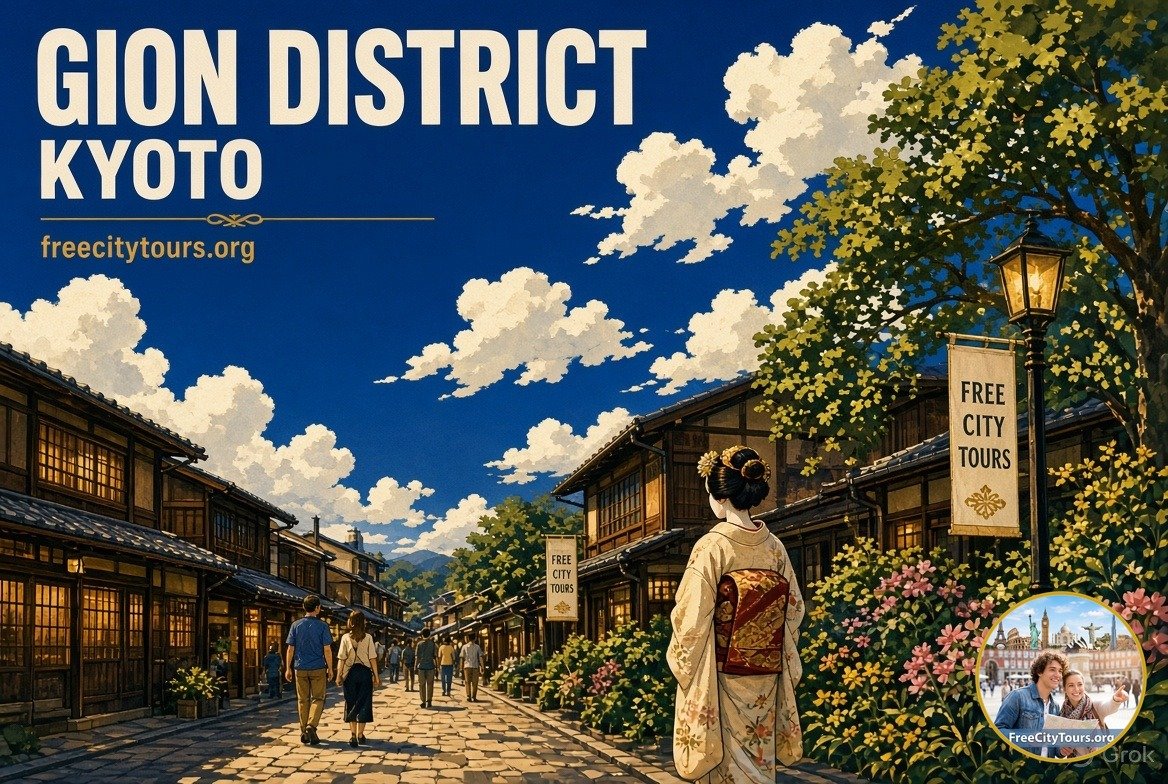
On this Kyoto walking tour, Gion is Kyoto’s most famous geisha district. Hanamikoji, its main lane, is lined with wooden teahouses where geiko, as geisha are called in Kyoto, and maiko, their apprentices, entertain guests in the evening. To the north, willows hang over the Shirakawa canal by the little Tatsumi Bridge. At the east end of Shijo-dori stands Yasaka Shrine, home of the Gion Matsuri, which fills the whole of July and is one of Japan’s best-known festivals.
At the other end of Gion, by the river, the Minami-za is Japan’s oldest kabuki theatre site. Best at dusk. Do not block or touch geiko or maiko for photos, and respect the signs banning photography in private lanes. Gion-Shijo (Keihan) or Kawaramachi (Hankyu). Walk this order on the Kyoto walking tour. Hanamikoji and the teahouses → geiko and maiko → Shirakawa and Tatsumi Bridge → Yasaka Shrine → Minami-za and the Gion Matsuri.
6. Nijo Castle
From stop 5 · subway to Nijojo-mae · 60–90 minutes
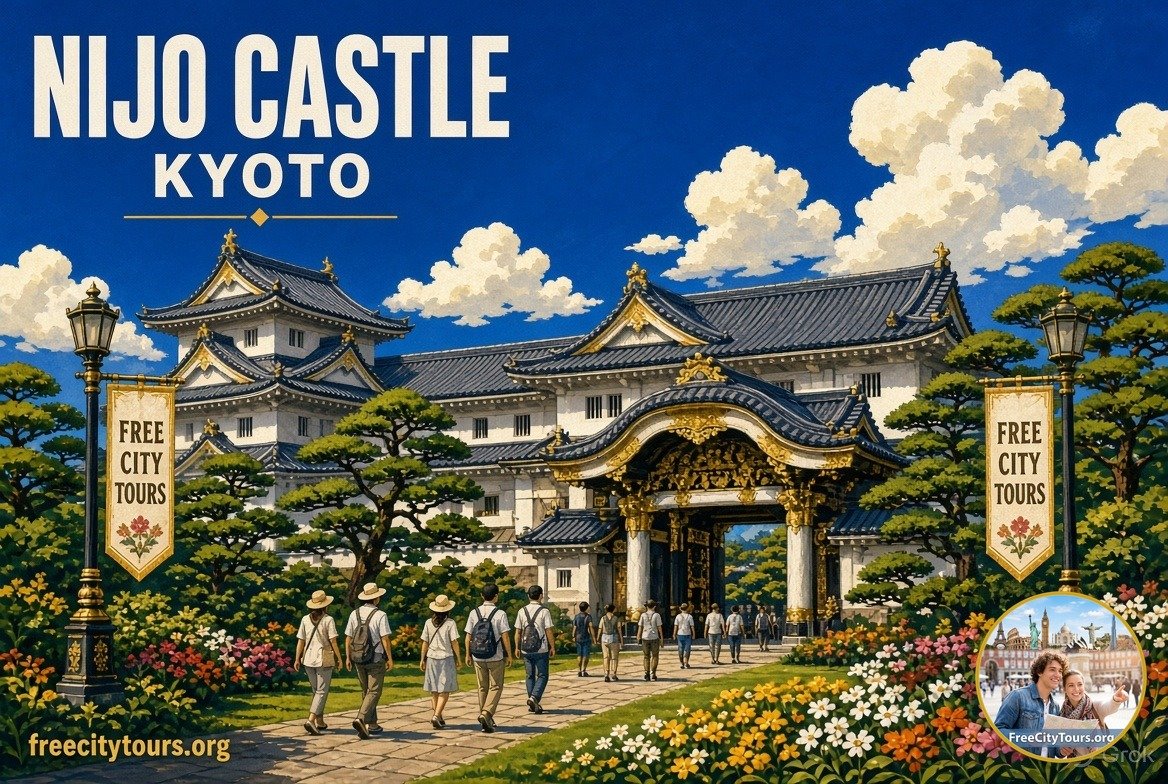
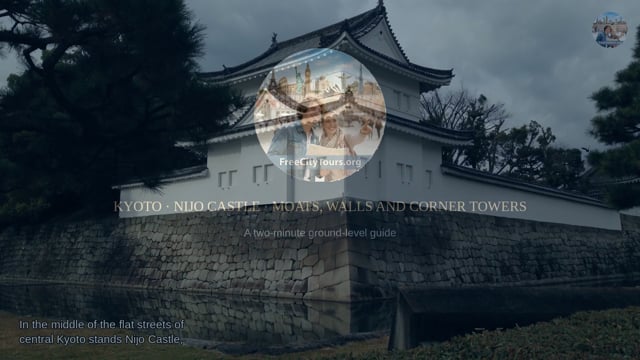
Along this Kyoto walking tour, Nijo Castle was built from 1603 as the Kyoto residence of the first Tokugawa shogun, Ieyasu, and it is part of the UNESCO World Heritage Site. Moats, stone walls and corner towers surround it. The richly carved and gilded Karamon Gate leads to the Ninomaru Palace, with rooms of painted sliding doors and “nightingale floors” that chirp when you walk on them. Here in 1867 the last shogun announced the return of power to the Emperor.
Beside the palace lie the Ninomaru Garden, with its pond and rocks, and the later Seiryu-en garden. The inner Honmaru keeps the stone base of the castle keep, which burned after a lightning strike in 1750. Open about 08:45–17:00 (last entry 16:00); closed on Tuesdays in some months, so check before you go. Walk this order on the Kyoto walking tour. Moats, walls and corner towers → the Karamon Gate → the Ninomaru Palace → the Ninomaru Garden and Seiryu-en → Honmaru and the keep base.
7. Philosopher’s Path
From stop 6 · bus 5 / 17 to Ginkakuji-michi
On this Kyoto walking tour, the Philosopher’s Path follows a cherry-lined canal for about two kilometres at the foot of the eastern hills. It is named after the philosopher Nishida Kitaro, who walked it every day. At the north end is Ginkaku-ji, the Silver Pavilion, built for the shogun Ashikaga Yoshimasa from 1482; it was never covered in silver, and its raked sand garden is as famous as the pavilion. Along the way, Honen-in is a quiet temple with a thatched gate and sand mounds, and Eikan-do is known for its autumn leaves.
At the south end, Nanzen-ji has a huge wooden gate and a red-brick aqueduct from 1890 that still carries water from Lake Biwa. The walk takes about 30 minutes without stops; best in cherry season. The temples charge entry, except the grounds of Honen-in and Nanzen-ji. Walk this order on the Kyoto walking tour. The canal and the philosopher → Ginkaku-ji, the Silver Pavilion → Honen-in → Eikan-do → Nanzen-ji and the aqueduct.




8. Ryoan-ji
From stop 7 · bus to Ryoanji-mae · 40–60 minutes
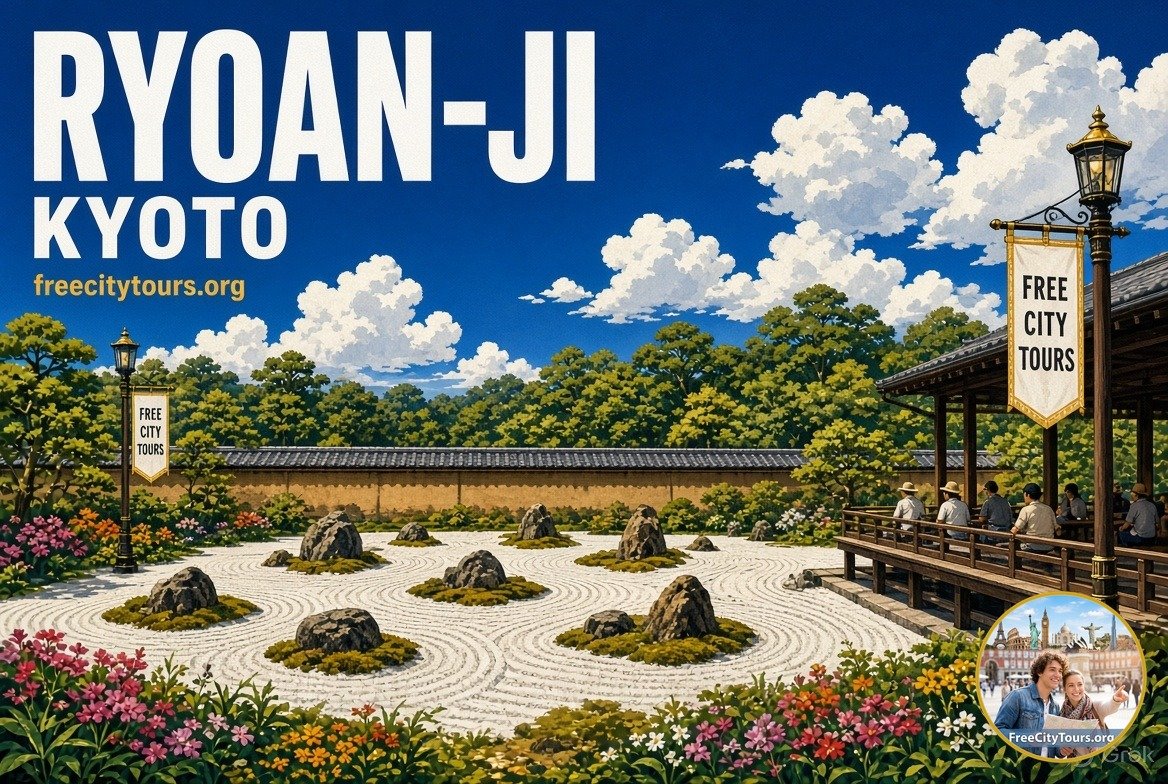
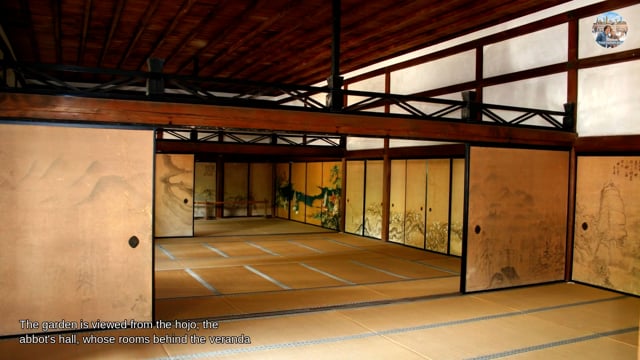
Along this Kyoto walking tour, Ryoan-ji is a Zen temple founded in 1450 and part of the UNESCO World Heritage Site. You walk first around the Kyoyochi Pond, then reach the most famous rock garden in Japan: fifteen stones set in raked white gravel, like islands in an empty sea. Nobody knows for sure who made it or what it means, and from any one seat you never see all fifteen stones at once.
Behind the hall, a stone water basin carries the words “I only know contentment”, set in a garden of moss. A short walk west along the Kinukake Road brings you to Ninna-ji, an imperial temple founded in 888, with a five-storied pagoda and late-blooming cherry trees. Open about 08:00–17:00. The Kinukake Road also links Ryoan-ji with Kinkaku-ji. Walk this order on the Kyoto walking tour. The Kyoyochi Pond → the rock garden → fifteen stones and an empty sea → the stone basin and the moss garden → Ninna-ji and the Kinukake Road.
9. Kyoto Imperial Palace
From stop 8 · subway to Imadegawa · 45–75 minutes
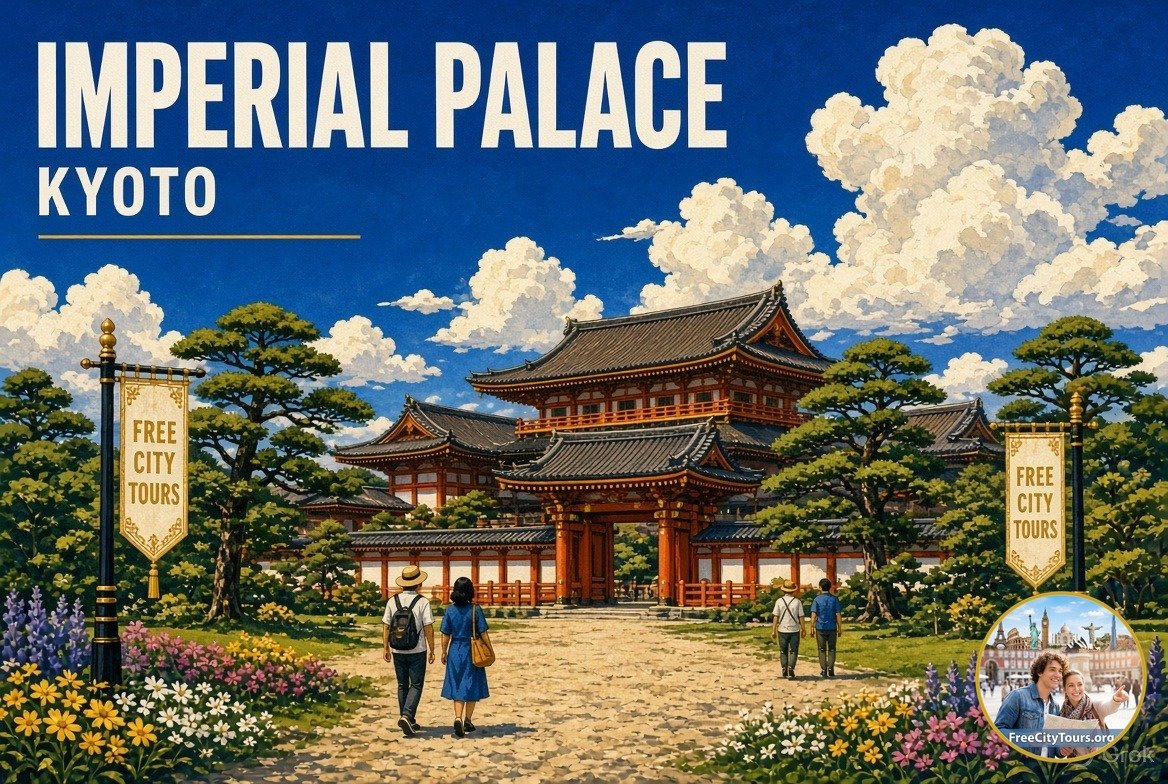
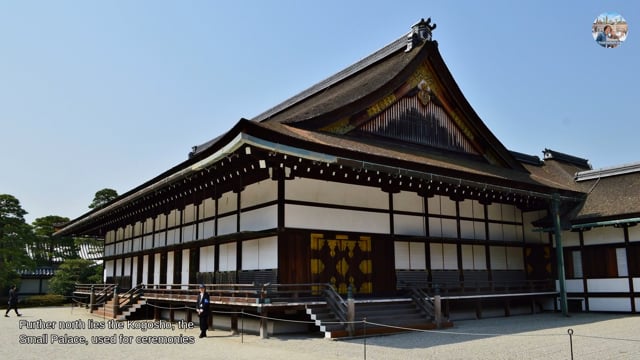
On this Kyoto walking tour, the Kyoto Imperial Palace was the home of Japan’s emperors until the capital moved to Tokyo in 1869; the present buildings date from 1855. The Shishinden, the hall for state ceremonies, saw the enthronement of the Taisho and Showa emperors. The Seiryoden was the emperor’s living quarters, and the Kogosho, the small palace, looks onto a pond garden.
Around the walled palace spreads the Kyoto Gyoen, a large free park with wide gravel paths, pines and plum and cherry trees. Palace entry is free; check the opening days and times before you go. Imadegawa Station on the Karasuma line. Walk this order on the Kyoto walking tour. The palace of the emperors → the Shishinden → the Seiryoden → the Kogosho and the pond garden → the Kyoto Gyoen.
10. Tenryu-ji
From stop 9 · JR Sagano Line to Saga-Arashiyama · last stop
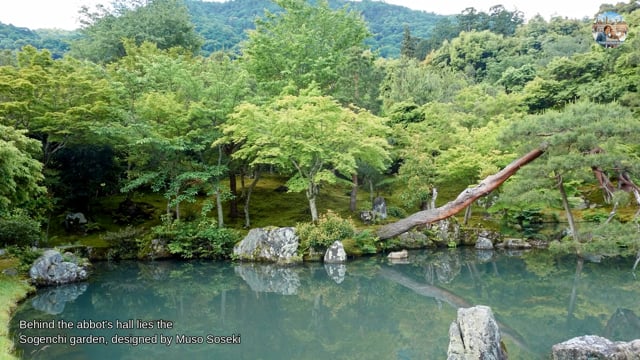
Along this Kyoto walking tour, Tenryu-ji, the Temple of the Heavenly Dragon, was founded in 1339 by the shogun Ashikaga Takauji in memory of Emperor Go-Daigo, and it ranks first among Kyoto’s five great Zen temples. It is part of the UNESCO World Heritage Site. On the ceiling of the Dharma Hall a great cloud dragon, painted in 1997, seems to watch you from every side; the hall opens on weekends and in special seasons. The abbot’s halls look onto the Sogenchi Garden, designed by the monk Muso Soseki in the 14th century, with its pond set against the Arashiyama hills.
Paths climb through the hillside garden, and the sub-temple Hogon-in opens in spring and autumn. Open about 08:30–17:00. Walk the garden, then exit by the north gate toward the bamboo grove; combine with stop 3 if you do Arashiyama as one block. Walk this order. The Temple of the Heavenly Dragon → the Dharma Hall and the cloud dragon → the abbot’s halls → the Sogenchi Garden → the hillside garden and Hogon-in.