Lisbon sits on the north bank of the Tagus, where the river widens before it meets the Atlantic. The old centre climbs over steep hills, and the 25 de Abril Bridge spans the water to the west. Much of the downtown was rebuilt on a grid after the earthquake of 1755.
Belém, on the riverfront to the west, holds the tower and the Jerónimos Monastery from the Age of Discovery. Alfama, the oldest quarter, tumbles down below São Jorge Castle. Praça do Comércio opens onto the river at the foot of the Baixa, and Bairro Alto fills the hill across the valley.
On this walk you start at Belém Tower and the monastery, cross to Alfama and climb to the castle, ride Tram 28, visit the Oceanário in Parque das Nações, come back to Praça do Comércio, go up to Bairro Alto, look in at LX Factory, and finish with a day trip to Sintra.
1. Lisbon walking tour: Belém Tower
Belém, on the Tagus riverfront · start here · 45–60 minutes
The first stop on this Lisbon walking tour, Belém Tower, was built between 1514 and 1519 for King Manuel I to guard the mouth of the Tagus, and it is one of the finest examples of the Manueline style, with carved ropes, armillary spheres and the cross of the Order of Christ. Its architect was Francisco de Arruda. The tower once stood on a small island in the river; the shoreline has since moved towards it. Together with the Jerónimos Monastery it has been a UNESCO World Heritage Site since 1983. A stone rhinoceros, thought to be the first sculpture of the animal in Western European art, is carved at the base of one of the watchtowers. A short walk east along the river stands the Monument to the Discoveries, 52 metres high, built in 1960 for the 500th anniversary of the death of Prince Henry the Navigator. The riverside is free; the tower interior needs a ticket.
Walk this order. Riverside approach → the Manueline stonework → inside the bastion → the rooftop terrace → east along the river to the Monument to the Discoveries → 15 minutes inland to the Jerónimos Monastery.
03 · Tour · videos inside this sight
Riverside Approach
Manueline Stonework
Inside the Bastion
Rooftop Terrace
Monument to the Discoveries
Advertisement
Ad slot
2. Lisbon walking tour: Jerónimos Monastery
From stop 1 · 15 minutes on foot along the river and through the gardens · 60–90 minutes
Next on the Lisbon walking tour, the Jerónimos Monastery was commissioned by King Manuel I and begun in 1501, close to the spot where Vasco da Gama set sail for India in 1497. Building went on for about a century, and the monastery was paid for largely with the wealth of the spice trade. The richly carved South Portal is the work of João de Castilho. Inside the Church of Santa Maria lie the tombs of Vasco da Gama and of the poet Luís de Camões. The two storey cloister is one of the masterpieces of the Manueline style. Two minutes away, the Antiga Confeitaria de Belém has sold its custard tarts, pastéis de Belém, since 1837. The church is free; the cloister needs a ticket.
Walk this order. Praça do Império and the long south front → the South Portal → the Church of Santa Maria → the Manueline cloister → pastéis de Belém on Rua de Belém → tram 15 back to the centre for the Alfama.
03 · Tour · videos inside this sight
Praça do Império Front
South Portal
Church of Santa Maria
Manueline Cloister
Pastéis de Belém
Advertisement
Ad slot
3. Lisbon walking tour: Alfama District
From stop 2 · tram 15 to Praça do Comércio, then 15 minutes uphill on foot or tram 28 · 2 hours
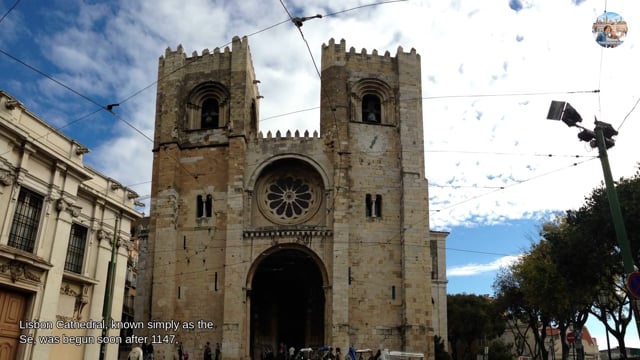
This stop on the Lisbon walking tour, the Alfama, is the oldest district of Lisbon, a maze of steep lanes and stairways below the castle hill whose name comes from the Arabic period. Much of it survived the earthquake of 1755. The Miradouro de Santa Luzia looks out over the rooftops to the Tagus. Lisbon Cathedral, the Sé, was begun in 1147, soon after Afonso Henriques took the city, and is the oldest church in Lisbon. Down by Largo do Chafariz de Dentro, the Fado Museum, opened in 1998, tells the story of the city’s song, which UNESCO added to its list of Intangible Cultural Heritage in 2011. Further east stand the monastery of São Vicente de Fora and the white dome of the National Pantheon, finished only in 1966. The streets are free; the museum and the Pantheon need tickets.
Walk this order. Santa Luzia viewpoint → Lisbon Cathedral → the Alfama lanes → the Fado Museum → São Vicente de Fora and the National Pantheon → back uphill to São Jorge Castle.
03 · Tour · videos inside this sight
Santa Luzia Viewpoint
Lisbon Cathedral
Alfama Lanes
Fado Museum
São Vicente and the Pantheon
Advertisement
Ad slot
4. Lisbon walking tour: São Jorge Castle
From stop 3 · 10 minutes uphill from Santa Luzia · 60–90 minutes
On your Lisbon walking tour, São Jorge Castle crowns the highest hill of old Lisbon. The walls go back to the Moorish period, and in 1147 the Christian army of Afonso Henriques captured the castle in the Siege of Lisbon. It then served as a royal palace until the early 1500s. Much of what stands today was rebuilt in the 1940s. The terrace by the parade ground has one of the widest views over the Baixa and the river. The archaeological site inside the walls shows remains of Moorish houses from the 11th century and traces of much older settlement, and peacocks roam the gardens. The castle needs a ticket.
Walk this order. Hilltop gates → the parade ground terrace → the walls and towers → the view over the Baixa → the archaeological site and the peacocks → down to Martim Moniz for Tram 28.
03 · Tour · videos inside this sight
Hilltop Gates
Parade Ground Terrace
Walls and Towers
View over the Baixa
Archaeological Site and Peacocks
Advertisement
Ad slot
5. Lisbon walking tour: Tram 28
From stop 4 · 15 minutes downhill to Martim Moniz · 45–60 minutes on the tram
For a ride on this Lisbon walking tour, Tram 28 is Lisbon’s best known tram line. It runs from Martim Moniz up through Graça, along the edge of the Alfama, down through the Baixa and Chiado and out past the Estrela Basilica to Campo de Ourique. Most journeys use the small yellow Remodelado cars, built in the 1930s and modernised in the 1990s, which can take curves and gradients too tight for modern trams. Near the Graça stop, the Miradouro da Graça looks across to the castle. At Estrela, the white domed basilica was completed in 1790, and the Estrela Garden lies opposite. Pay with a Viva Viagem card or buy a ticket on board; start at Martim Moniz to get a seat.
Walk this order. Martim Moniz terminus → aboard a Remodelado → the Graça viewpoint → narrow streets and steep hills → Estrela and the end of the line → metro to Oriente for the Oceanário.
03 · Tour · videos inside this sight
Martim Moniz Terminus
Aboard a Remodelado
Graça Viewpoint
Narrow Streets and Steep Hills
Estrela and the End of the Line
Advertisement
Ad slot
6. Lisbon walking tour: Oceanário de Lisboa
From stop 5 · metro red line to Oriente, then 10 minutes on foot · 2 hours
Out east on the Lisbon walking tour, the Oceanário de Lisboa opened in 1998 for Expo 98 in what is now the Parque das Nações. It was designed by the American architect Peter Chermayeff and stands on a pier in a dock of the Tagus. At its centre is one large tank of about five million litres of seawater, home to sharks, rays and shoals of fish. Around it, four habitats show the coasts of the North Atlantic, the Antarctic, the temperate Pacific with its sea otters, and the tropical Indian Ocean. The Oceanário needs a ticket.
Walk this order. The building on the water → the global ocean tank → the Atlantic and Antarctic coasts → the temperate Pacific → the tropical Indian Ocean → metro back to Baixa-Chiado for Praça do Comércio.
03 · Tour · videos inside this sight
Building on the Water
Global Ocean Tank
Atlantic and Antarctic Coasts
Temperate Pacific
Tropical Indian Ocean
Advertisement
Ad slot
7. Lisbon walking tour: Praça do Comércio
From stop 6 · metro to Terreiro do Paço · 45 minutes
On this Lisbon walking tour, Praça do Comércio, still often called Terreiro do Paço, stands where the royal Ribeira Palace stood until it was destroyed by the earthquake and tsunami of 1755. The Marquis of Pombal had the square rebuilt as an open space facing the Tagus, framed on three sides by arcaded yellow buildings. In the centre is the bronze equestrian statue of King José I by Joaquim Machado de Castro, unveiled in 1775. On the north side the Rua Augusta Arch, completed in 1875, leads into the grid of the Baixa. On the riverfront, the marble steps of the Cais das Colunas go down into the water. The square is free; the viewing platform on top of the arch needs a ticket.
Walk this order. The palace yard → the statue of King José I → the Rua Augusta Arch → the Cais das Colunas → Rua Augusta and the arcades → uphill through Chiado to the Bairro Alto.
03 · Tour · videos inside this sight
The Palace Yard
King José Statue
Rua Augusta Arch
Cais das Colunas
Rua Augusta and the Arcades
Advertisement
Ad slot
8. Lisbon walking tour: Bairro Alto
From stop 7 · 20 minutes uphill through the Chiado · 60–90 minutes, more at night
This Lisbon walking tour also climbs to the Bairro Alto, the Upper Town, which was laid out in the 16th century on a regular grid of narrow streets. The Miradouro de São Pedro de Alcântara looks east across the Baixa to the castle. The Jesuit Church of São Roque, from the 16th century, holds the Chapel of Saint John the Baptist, made in Rome in the 1740s and shipped to Lisbon. Nearby, the Carmo Convent, founded in 1389, has stood roofless since the earthquake of 1755; its Gothic arches now frame an archaeological museum. By day the streets are quiet; at night the bars and fado houses fill them with people. The streets are free; the Carmo ruins need a ticket.
Walk this order. São Pedro de Alcântara viewpoint → the Church of São Roque → the Carmo Convent ruins → the streets of the Upper Town → the Bairro Alto by night → tram 15 or a short taxi west to Alcântara for LX Factory.
03 · Tour · videos inside this sight
São Pedro de Alcântara Viewpoint
Church of São Roque
Carmo Convent Ruins
Streets of the Upper Town
Bairro Alto by Night
Advertisement
Ad slot
9. LX Factory
From stop 8 · tram 15 or bus to Calvário in Alcântara, then 5 minutes on foot · 60–90 minutes
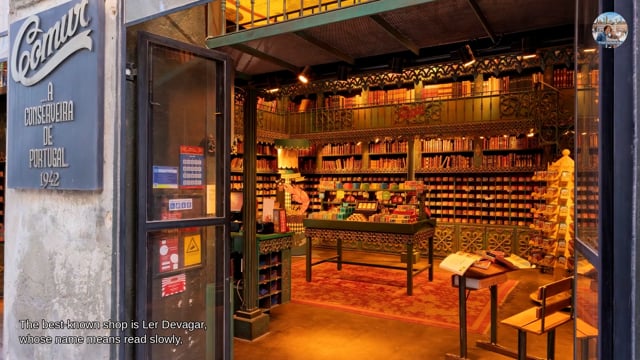
Near the bridge on the Lisbon walking tour, LX Factory occupies an industrial complex in Alcântara that was built from 1846 for a textile company, the Companhia de Fiação e Tecidos Lisbonense, and later used by printers and other industries. Since 2008 it has been a creative quarter of studios, shops, cafés and restaurants. Large murals cover many of its walls, and the Ler Devagar bookshop fills a former printing hall. The complex sits right beside the 25 de Abril Bridge, the suspension bridge over the Tagus opened in 1966. Entry is free.
Walk this order. The old textile mill → murals and street art → bookshops and studios → food and rooftops → under the April Bridge → train from Rossio to Sintra.
03 · Tour · videos inside this sight
The Old Textile Mill
Murals and Street Art
Bookshops and Studios
Food and Rooftops
Under the April Bridge
Advertisement
Ad slot
10. Sintra
From stop 9 · train from Rossio station to Sintra, about 40 minutes, then bus or a steep walk up the hill · a full day
The day trip that ends this Lisbon walking tour, Sintra, lies in the hills about 25 kilometres west of Lisbon, and its Cultural Landscape has been a UNESCO World Heritage Site since 1995. The Pena Palace, painted in red and yellow, was built for King Ferdinand II and completed in the 1850s, a landmark of 19th century Romanticism. On the next ridge run the walls of the Castle of the Moors, first built in the 8th and 9th centuries. Quinta da Regaleira was created in the early 1900s by the architect Luigi Manini for António Augusto Carvalho Monteiro, with gardens, grottoes and the spiralling Initiation Well. In the town centre, the National Palace of Sintra, with its two great white chimneys, was used by the Portuguese royal family from the 15th to the 19th century. Each palace needs its own ticket.
Walk this order. The Pena Palace → inside the royal rooms → the Castle of the Moors → Quinta da Regaleira → the National Palace in the town centre → train back to Rossio.
03 · Tour · videos inside this sight
The Pena Palace
Inside the Royal Rooms
The Castle of the Moors
Quinta da Regaleira
The National Palace
Lisbon Walking Tour Overview Detail
This Lisbon walking tour links 10 sights and 50 short video stops narrated by Clarissa, from the riverside monuments of Belém to the palaces of Sintra. The notes below turn those stops into practical day plans, with walking order, timing, transport, etiquette and the free sights worth knowing before you go. For official visitor information and events, also check Visit Lisboa, the official tourism site of Lisbon.
Best routes for your Lisbon walking tour using the 50 stops
Route 1, Belém (stops 1, 2 and 9). Start at Belém Tower, the fortified tower on the bank of the Tagus, and walk along the river past the Monument to the Discoveries to Jerónimos Monastery, a masterpiece of the ornate Manueline style. Both are UNESCO World Heritage sites. Stop for a custard tart at the famous bakery nearby, then take the tram or train back toward the centre and get off at Alcântara for LX Factory, a former industrial complex under the 25 de Abril Bridge, now full of shops, cafés and street art.
Route 2, Alfama and the castle (stops 3 to 5). Climb into Alfama, Lisbon's oldest quarter, a maze of steep lanes, stairways and small squares that largely survived the earthquake of 1755. Look out from the Miradouro de Santa Luzia and the Miradouro das Portas do Sol over the rooftops to the river, then climb to São Jorge Castle on the hilltop, with its walls, towers and the best view of the city. Ride the yellow Tram 28 through the narrow streets of Graça and down to the Baixa.
Route 3, the Baixa and Bairro Alto (stops 7 and 8). Walk down Rua Augusta through the grid of the Baixa, rebuilt by the Marquis of Pombal after the earthquake, to the Praça do Comércio, the great riverside square under the Rua Augusta Arch. Then climb through Chiado to Bairro Alto, the old hilltop quarter that is quiet by day and full of bars and fado houses by night, and finish at the Miradouro de São Pedro de Alcântara for the sunset.
Route 4, the Parque das Nações (stop 6). Take the metro east to the Oriente station for the Oceanário de Lisboa, one of the largest aquariums in Europe, built for Expo 98. Walk along the modern riverside promenade, with its gardens and views of the long Vasco da Gama Bridge.
Day trip, Sintra (stop 10). Trains run from Rossio station in central Lisbon to Sintra, about 40 minutes away, with its romantic palaces, gardens and the Moorish Castle on wooded hills. The Cultural Landscape of Sintra is a UNESCO World Heritage Site. Plan a full day, start early and book palace tickets in advance, because Sintra gets very busy.
From the Praça do Comércio, a flat riverside promenade leads west to Cais do Sodré, the old waterfront district with its food market hall and the bars of Pink Street. Ferries leave from here and from the nearby river stations across the Tagus to Cacilhas, a short ride with one of the best views back over the city. It makes an easy, low-effort end to a day on a Lisbon walking tour.
If you only have one day, Routes 2 and 3 give the best Lisbon walking tour on foot, because Alfama, the castle, the Baixa and Bairro Alto form one connected walk. A three-day Lisbon walking tour works well as Routes 2 and 3 on day one, Belém, LX Factory and the Oceanário on day two, and Sintra on day three.
Best times and transport for a Lisbon walking tour
Spring and autumn are the best seasons for a long Lisbon walking tour, with warm sunshine and fewer crowds than midsummer. In June, the Santo António festival fills Alfama and other old quarters with street parties, grilled sardines and music. Summer is hot and busy, so walk early, rest in the afternoon and head out again for the evening. Winter is mild but can be rainy.
Many of Lisbon's monuments and museums close on Mondays, including several sights in Belém, so check opening times on the official websites before you plan Route 1. Arrive early at Belém Tower and Jerónimos Monastery, where the queues are longest in the late morning. The Lisboa Card, sold by the city's tourism office, combines public transport with free or reduced entry to many sights, and can pay off on a busy sightseeing day.
Lisbon is built on steep hills, and the trams, funiculars, the Santa Justa Lift, buses and the metro all help. Buy a rechargeable Viva Viagem card for public transport, and consider a day ticket if you plan many rides. Tram 28 fills up quickly, so board at its terminus at Martim Moniz to get a seat.
Use the Map button at each stop to check walking time. Distances look short on the map, but the hills make them slower, so plan your Lisbon walking tour downhill where you can, for example from the castle down through Alfama to the river.
Etiquette, food and safety on your Lisbon walking tour
Churches such as the Sé, Lisbon Cathedral, and the church of Jerónimos are places of worship, so keep your voice low and avoid sightseeing during services. In Alfama, people live in the narrow lanes, so keep the noise down, especially in the evening, and don't photograph residents without asking.
For food, try pastéis de nata, the custard tarts sold all over the city, grilled sardines in summer, bacalhau, the salted cod cooked in many ways, and a bifana, a pork sandwich. Ginjinha, a cherry liqueur, is served in small shops near Rossio. Restaurants may bring bread, olives and cheese to the table, which are usually charged if you eat them, so send them back if you don't want them on your Lisbon walking tour.
Lisbon is generally safe, but pickpockets work the crowded trams, especially Tram 28, as well as the viewpoints and the Baixa, so keep your bag closed and in front of you. Ignore street sellers who offer drugs in the Baixa and Bairro Alto.
Wear shoes with a good grip, because the hills are steep and the traditional patterned pavements, the calçada portuguesa, become slippery, especially in the rain. Carry water in summer, as the climbs to the viewpoints are hot.
Free sights, tickets and accessibility on a Lisbon walking tour
Many stops cost nothing at all. The riverside at Belém, the church of Jerónimos Monastery, the lanes of Alfama, the Praça do Comércio, Bairro Alto, LX Factory and the city's many viewpoints are free to visit. Belém Tower, the monastery cloister, São Jorge Castle, the Oceanário and the palaces of Sintra need tickets, and Tram 28 needs a fare. That is why this free walking tour Lisbon visitors can start at any hour works well: the 50 videos are free, and you only pay for what you choose to enter.
The miradouros, Lisbon's viewpoints, are the city's best free extra. The Miradouro da Senhora do Monte and the Miradouro da Graça look over the castle and the river, and many of them have a kiosk café. Always confirm current prices and opening hours on each official website before your Lisbon walking tour.
Knowing a little history helps the stops make sense. On 1 November 1755, a huge earthquake, followed by a tsunami and fires, destroyed much of the city. The Baixa you walk through today, with its straight streets and uniform buildings, is the planned city that rose afterwards, while Alfama and the castle hill keep the older, twisting street pattern. You can see both sides of that story on one Lisbon walking tour.
For accessibility, Belém, the Praça do Comércio, the Baixa and the Parque das Nações are flat and the easiest areas for wheelchair users and strollers. Alfama, the castle hill and Bairro Alto are steep and have stairs and cobbles. The historic trams have high steps, while the metro and many buses are more accessible, and the Santa Justa Lift links the Baixa with Chiado.
Yes. All 50 video stops on this Lisbon walking tour are free to watch, and Alfama, the Praça do Comércio, Bairro Alto, LX Factory, the church of Jerónimos and the viewpoints are free to visit. You only pay for the sights you choose to enter, such as the castle or Belém Tower. It is a genuine free walking tour Lisbon visitors can follow at their own pace.
How long does the Lisbon walking tour take?
Allow three days to see everything properly: one for Alfama, the castle, the Baixa and Bairro Alto, one for Belém, LX Factory and the Oceanário, and one for Sintra. With one day, follow Routes 2 and 3.
Where does the Lisbon walking tour start?
The videos start at Belém Tower, but you can join at any stop, because each one has its own Map button and five short videos. Many visitors begin in Alfama or the Baixa instead.
Is the Lisbon walking tour suitable for children and wheelchair users?
Yes, with some planning. Children love the Oceanário, the castle and the tram ride. Wheelchair users will find Belém, the Baixa and the Parque das Nações the easiest areas, while Alfama and Bairro Alto are steep.
Do I need an app or mobile data for the Lisbon walking tour?
You don't need an app. Open this page in your phone's browser and play the videos as you walk. The videos stream, so use mobile data or café Wi-Fi, or watch them at your hotel the night before.