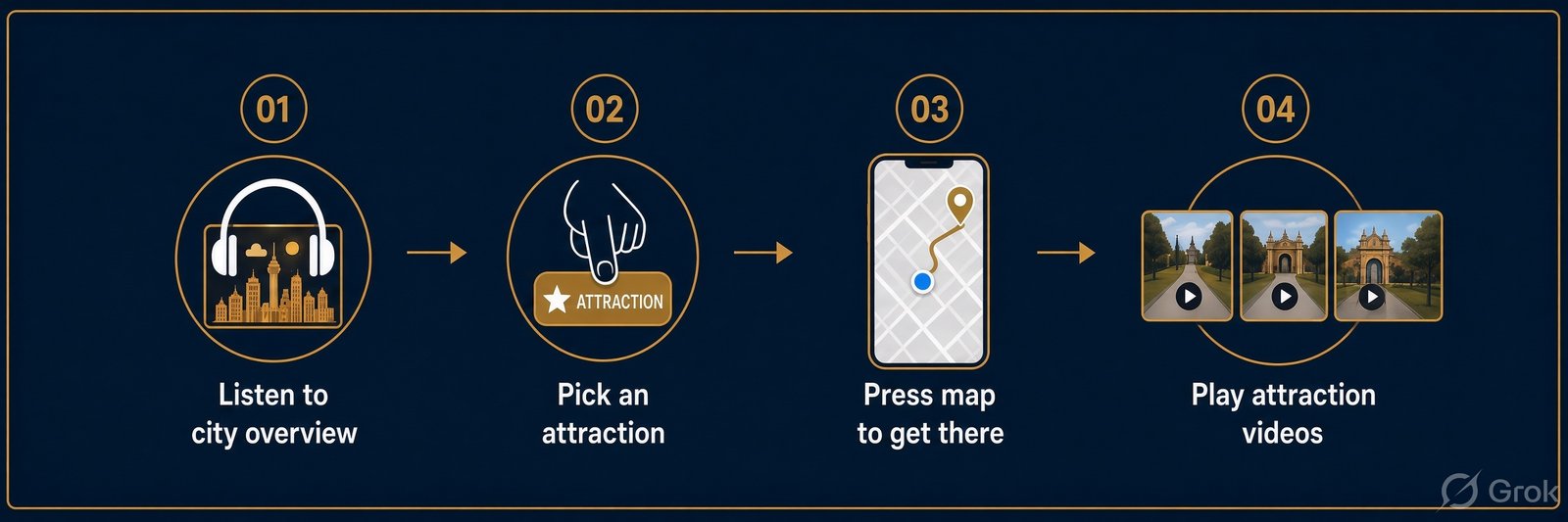
Warsaw Walking Tour Overview Detail
This Warsaw walking tour links 10 sights and 50 short video stops narrated by Clarissa, from the rebuilt Old Town to the modern riverside on the Vistula. The notes below turn those stops into practical day plans, with walking order, timing, transport, etiquette and the free sights worth knowing before you go. For official visitor information and events, also check Go to Warsaw, the official tourism website of the City of Warsaw.
Best routes for your Warsaw walking tour using the 50 stops
Route 1, the royal heart (stops 1, 2 and 9). Start in the Old Town, founded in the late 13th century, destroyed in 1944 and rebuilt after the war from paintings and plans, a reconstruction now listed by UNESCO. Follow the videos around the Market Square and the Mermaid statue, the symbol of the city, to Saint John's Archcathedral and the red-brick Barbican and walls. Then step onto Castle Square for the Royal Castle, rebuilt in the 1970s and 1980s with donations from Poles around the world, and Sigismund's Column, raised in 1644 and rebuilt in 1949.
Route 2, the Royal Route (stops 6, 3 and 4). Walk south along Krakowskie Przedmieście, past Saint Anne's Church, the Presidential Palace and the main campus of the University of Warsaw to the Holy Cross Church, where an urn holding Chopin's heart is kept inside a pillar. Detour west to the Palace of Culture and Science, completed in 1955, for the view from the 30th-floor terrace. Then continue down the Royal Route to Łazienki Park for the Chopin Monument, the Palace on the Isle and its open-air theatre, and the peacocks in the gardens.
Route 3, history museums (stops 7 and 8). Give the POLIN Museum of the History of Polish Jews a half day. It opened in 2013 in Muranów, the former Jewish district, facing the Ghetto Heroes Monument, and tells a thousand years of Jewish life in Poland. On another half day, visit the Warsaw Uprising Museum in Wola, opened in 2004 in a former tram power station, which tells the story of the 63 days that began at 5 pm on 1 August 1944.
Route 4, palace and river (stops 5 and 10). Take the bus south to Wilanów Palace, the late 17th-century summer residence of King Jan III Sobieski, often called the Polish Versailles, with baroque gardens running down to a lake. Return to the centre for the Vistula River Boulevards, the riverside promenade near the Old Town, with the Multimedia Fountain Park, the riverside Mermaid and the Copernicus Science Centre at the end of the walk.
If you only have one day, Routes 1 and 2 give the best Warsaw walking tour on foot, because the Old Town, Castle Square and the Royal Route form one continuous walk. A three-day Warsaw walking tour works well as Routes 1 and 2 on day one, the two museums on day two, and Wilanów with an evening on the Vistula boulevards on day three.
For photos, the best free viewpoints on this Warsaw walking tour are Castle Square with Sigismund's Column and the Old Town roofs behind it, the Market Square in the early morning, the Palace on the Isle reflected in its lake, and the Vistula boulevards at sunset. For the view from above, the terrace of the Palace of Culture and Science and the bell tower of Saint Anne's Church both look over the whole city.
Best times and transport for a Warsaw walking tour
Late spring to early autumn is the best season for a long Warsaw walking tour, with long days, open-air concerts in Łazienki Park and busy riverside bars along the Vistula. Winters are cold and can be snowy, but the Royal Route and the Old Town are lit up for the Christmas season. Every year on 1 August at 5 pm, sirens sound and the city stops for a minute to remember the Warsaw Uprising, a powerful moment to witness.
Plan the museums around their weekly closing days and any free-entry days, which differ from museum to museum, and book timed tickets for POLIN and the Royal Castle in busy periods. Check each museum's official website for current opening times before your Warsaw walking tour. Note that most shops in Poland close on most Sundays under the national trading rules, while museums, restaurants and cafés stay open.
Warsaw has two metro lines and a dense network of trams and buses, all run by the city's public transport authority. One time-based ticket covers all of them, and you can pay by contactless card at the validators on board or buy tickets from machines. Validate a paper ticket as soon as you board, because inspectors check often. Wilanów is easiest by bus, and the POLIN and Uprising museums are short tram rides from the centre.
Use the Map button at each stop to check walking time. The Old Town and the Royal Route are compact and walkable, but Łazienki, Wilanów and the two museums are further out, so mix walking with short rides on your Warsaw walking tour.
For the evening, the light and music shows at the Multimedia Fountain Park on the Vistula run in the warmer months, on set evenings each week, so check the city's official schedule before you plan your last stop. The open-air Chopin concerts in Łazienki Park are also seasonal and draw big crowds, so arrive early and bring something to sit on.
Etiquette, food and safety on your Warsaw walking tour
Warsaw remembers its wartime history in many places, from plaques marking where people were executed to the memorials around Muranów and the Uprising Museum. Pause quietly at these sites and avoid posing for playful photos. Inside Saint John's Archcathedral, Saint Anne's Church and the Holy Cross Church, keep your voice down and avoid visiting during Mass.
For food, try pierogi, the dumplings filled with potato and cheese, meat or fruit, and żurek, a sour rye soup often served in a bread bowl. Traditional milk bars, called bar mleczny, serve simple Polish dishes at very low prices and are a great lunch stop on a Warsaw walking tour. Look out for Wedel chocolate, a Warsaw brand, and pączki doughnuts with rose jam. In restaurants, a tip of around 10% is usual for good service.
Warsaw is a safe city, but watch your bag on crowded trams, at the main station and in the Old Town on summer evenings. Use official taxis or ride-hailing apps. Cross only at marked crossings and on the green light, because jaywalking can lead to a fine.
Wear comfortable shoes, because the Old Town is cobbled and the Royal Route is long. Bring a warm, waterproof layer in spring and autumn and full winter clothing from December to February, when temperatures often drop below freezing.
Free sights, tickets and accessibility on a Warsaw walking tour
Many stops cost nothing at all. The Old Town, the Market Square, Castle Square, Sigismund's Column, Krakowskie Przedmieście, the grounds of Łazienki Park and the Vistula River Boulevards are free to walk, and the summer Chopin concerts by the Chopin Monument and the fountain shows on the river are free to watch. The Royal Castle, the Palace on the Isle, Wilanów Palace, the Palace of Culture terrace and the two museums need tickets. That is why this free walking tour Warsaw visitors can start at any hour works well: the 50 videos are free, and you only pay for what you choose to enter.
Several Warsaw museums offer one free-entry day a week for their permanent exhibitions, but the day differs for each museum and the rules can change. Always check the current prices, free days and opening hours on each official website before your Warsaw walking tour.
For accessibility, the Royal Route and the Vistula boulevards are wide and mostly flat, which makes them the easiest stops for wheelchair users and strollers. The Old Town has cobbles and some slopes. The metro stations have lifts, many trams and buses are low-floor, and the major museums, including POLIN and the Uprising Museum, have step-free access.
When you finish this Warsaw walking tour, carry on with more free walks in Central and Eastern Europe: the Krakow walking tour, the Berlin walking tour, the Prague walking tour and the Vilnius walking tour. You can browse every city on the Free City Tours home page.
Warsaw walking tour FAQ
Is this Warsaw walking tour really free?
Yes. All 50 video stops on this Warsaw walking tour are free to watch, and the Old Town, Castle Square, the Royal Route, the grounds of Łazienki Park and the Vistula boulevards are free to walk. You only pay for the sights you choose to enter, such as the Royal Castle, Wilanów Palace or the museums. It is a genuine free walking tour Warsaw visitors can follow at their own pace.
How long does the Warsaw walking tour take?
Allow three days to see everything properly: one for the Old Town, the Royal Castle and the Royal Route to Łazienki, one for the POLIN and Uprising museums, and one for Wilanów and the Vistula boulevards. With one day, follow Routes 1 and 2 on foot.
Where does the Warsaw walking tour start?
It starts in the Old Town on the Market Square, with the Market Square video. You can join at any stop, because each one has its own Map button and five short videos.
Is the Warsaw walking tour suitable for children and wheelchair users?
Yes, with some planning. Children enjoy the peacocks in Łazienki Park, the fountain shows and the Copernicus Science Centre by the river. Wheelchair users will find the Royal Route and the Vistula boulevards the easiest stops, while the Old Town is cobbled.
Do I need an app or mobile data for the Warsaw walking tour?
You don't need an app. Open this page in your phone's browser and play the videos as you walk. The videos stream, so use mobile data or café Wi-Fi, or watch them at your hotel the night before.