Vienna Christmas Market Guide: The Best Markets and How to Visit Them
A Vienna Christmas market is not one market but a whole season of them: in 2026 the city has 15 official Christmas markets with 814 stalls, according to the city’s market authority, spread from the grand squares of the First District out to the palaces and the neighbourhood streets. Most are free to walk into, most are within a short ride on the U-Bahn, and the biggest names (Rathausplatz, Schönbrunn, Spittelberg) are as good as everyone says.
This guide is the overview: what the Vienna Christmas markets are, which ones are worth your time, what it costs, and how to spend one day among them on foot. It is written for first-time visitors, so it is practical rather than exhaustive. For dates, maps and food there are separate guides, which we link as we go.
Vienna’s Christmas market tradition, in brief
Vienna’s tradition is the Christkindlmarkt, the “Christ Child market”, which gave its name to the best-known market, the Wiener Christkindlmarkt on Rathausplatz. The idea is simple: wooden stalls, a mix of crafts and food, and cups of hot punch (Punsch) or mulled wine (Glühwein), set in front of something grand. In Vienna the “something grand” is usually a palace, a cathedral or the City Hall.
What sets Vienna apart from many other cities is the number and variety. The markets are spread out and each has its own character, so a visit is less like going to one event and more like choosing a few favourites. The city’s Marktamt (market authority) approved 15 markets this year, including 198 food and drink stalls. The first opened on 6 November, and by about 20 November the markets are mostly in full swing.
The main markets at a glance
Here are the markets most visitors will care about. We have not listed every neighbourhood market. Stall numbers are the city’s own figures for 2026.
| Market | Area | Character |
|---|---|---|
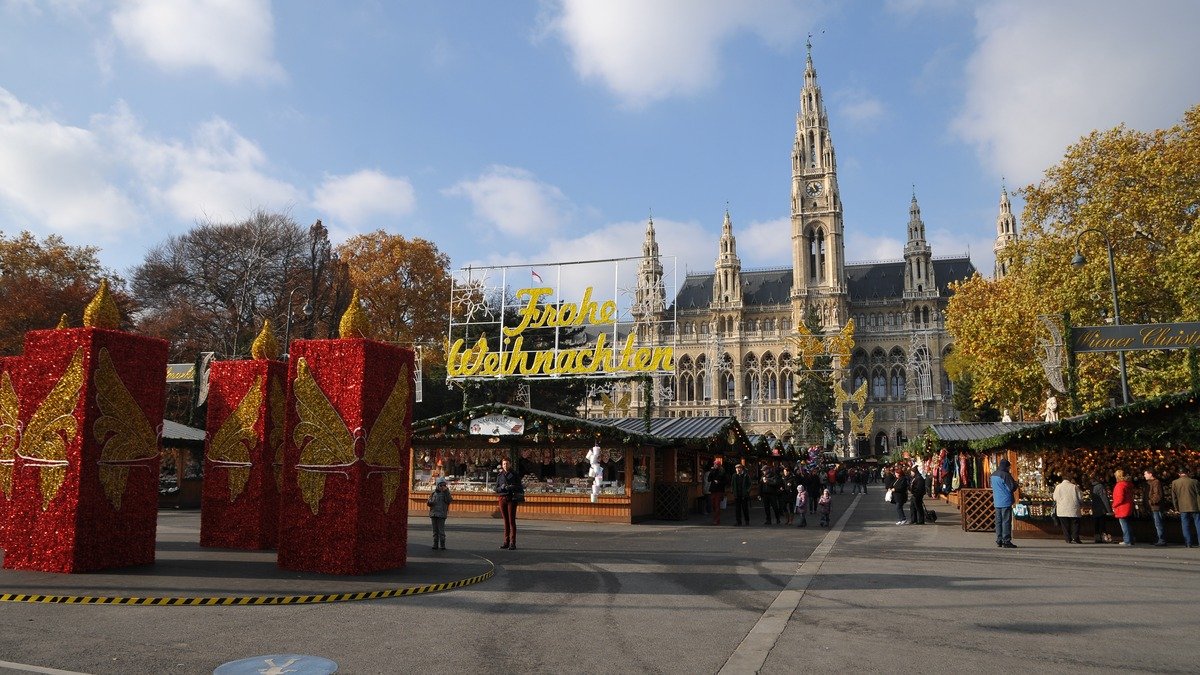
| Christkindlmarkt, Rathausplatz | 1st district, in front of City Hall | The famous one. 97 stalls, with a large ice-skating area, a children’s area and a multi-storey carousel in the park. |
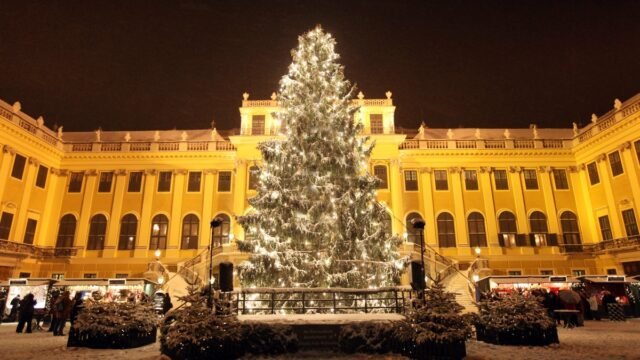
| Schönbrunn Palace | 13th district, palace courtyard | 99 stalls in front of the Habsburgs’ summer palace, with ice skating, curling lanes and rides. A U-Bahn trip from the centre. |
| Spittelberg | 7th district, behind the museums | The largest by stall count (122), in narrow, cobbled lanes. Mostly crafts, with 22 food and drink stalls. |
| Altwiener Christkindlmarkt, Freyung | 1st district | A traditional market on a historic square, in its 39th year. 57 stalls. |
| Am Hof | 1st district | A market on a city-centre square, with 76 stalls, a third of them food and drink. |
| Stephansplatz | 1st district, next to St Stephen’s Cathedral | A smaller market (44 stalls) right beside the cathedral, handy for a quick stop. |
| Maria-Theresien-Platz | 1st district, between the big museums | The “Weihnachtsdorf” (Christmas village), 44 stalls, opening on 20 November. |
| Art Advent, Karlsplatz | 4th district, beside the Karlskirche | Arts, crafts and demonstration workshops, with organic food. 83 stalls. |
| K&K Weihnachtsmarkt, Belvedere | 3rd district, at Schloss Belvedere | A themed market with an imperial flavour and 38 stalls, opening on 20 November. |
| Uni Campus (Altes AKH) | 9th district, university courtyards | 43 stalls in a series of courtyards, with a children’s programme at weekends. |
Two details are worth knowing about the biggest name. The Rathausplatz market itself is free to walk around, but the skating in the park, the “Ice Dream” (Eistraum), is a separate ticketed activity that runs from 13 November to 6 January and closes on 31 December. And it is the easiest market to reach by public transport: trams 1, D and 71 stop at Rathausplatz/Burgtheater, tram 2 at Parliament, and the U2 at Rathaus.
Most of these are open every day of the season, with slightly different hours. For each market’s opening and closing dates, see Vienna Christmas Market Dates 2026.
Which market should you visit, depending on your day
- If you have one evening: go to Rathausplatz. The Rathaus (City Hall) is lit up, the market is open until 10pm, and it is the most “Vienna Christmas market” of them all. It is also on the Ringstrasse, so it is easy to reach.
- If you want a palace backdrop: choose Schönbrunn, or the Belvedere market. Our guide to the Schönbrunn Christmas market has the practical details.
- If you like crafts more than crowds: try Freyung, Karlsplatz (Art Advent) or Spittelberg. Spittelberg also has the most stalls, so it is a good one for gifts.
- If you are with children: Rathausplatz has a free children’s ice rink and a reindeer train, and Schönbrunn has a free ice rink for children and a carousel. The Uni Campus market has a children’s programme at weekends.
- If you only have a few minutes: Stephansplatz is next to the cathedral and Am Hof is a short walk from Freyung.
For a closer look at one of the city-centre markets, see Freyung Christmas Market.
A one-day overview itinerary
You can see five or six of these markets in a day if you stay in the city centre. This is a sketch, not a full route; the Vienna Christmas Market map and walking route has the order and the walking times.
- Morning (optional): Schönbrunn. Take the U4 to Schönbrunn, about 600 metres from the market according to the organisers. The market opens at 10am. Allow around two hours, or longer if you add the palace or its grounds.
- Early afternoon: Stephansplatz, Am Hof and Freyung. These are all in the First District and close together on foot. Stop for a punch and something to eat.
- Late afternoon: Rathausplatz. Time your arrival for dusk, when the lights come on. The market is open until 10pm.
- Evening: Maria-Theresien-Platz and Spittelberg. These two are a short walk from each other, with Spittelberg open until 9.30pm (check the hours for the day you go).
If you cannot manage Schönbrunn, skip it. You will still have an excellent day in the centre.
What it costs, and what is free
Entry is free. The official Schönbrunn pages state that entry to the market is free, and the other markets are open public squares and courtyards where you pay for what you buy. Things that cost extra are ice skating, curling lanes (reserved online at Schönbrunn), rides and, at Schönbrunn, the palace itself.
Punch and the mug deposit. A cup of punch or mulled wine typically costs around €5 to €7. In early November the city’s press reported prices from €4.80, and up to about €7.90 for a punch with spirits. Drinks come in a collectable mug, and you pay a deposit that you get back when you return the mug. The deposits that have been confirmed for 2026 are €5 at Schönbrunn, Stephansplatz, Maria-Theresien-Platz and the Uni Campus market, and from €3 at Spittelberg. At the time of writing the organisers of some of the other markets, including Rathausplatz, had not published theirs, so ask at the stall. Return the mug to any stall at the same market to get your deposit back.
Food. Prices vary a great deal, so check the board before you order. If you want to eat a proper meal, a sit-down restaurant is usually better value than a string of market snacks.
Getting between the markets
The First District markets (Rathausplatz, Freyung, Am Hof and Stephansplatz) are close enough to walk. Using a walking-route calculator, we found that Freyung to Am Hof is about 3 minutes, Am Hof to Stephansplatz about 7 minutes, and Rathausplatz to Freyung about 7 or 8 minutes, so a loop of these four takes well under an hour without stops. Maria-Theresien-Platz and Spittelberg are a few minutes’ walk from each other. For the others, take public transport: Schönbrunn is on the U4 (U4 Schönbrunn and U4 Hietzing stations are each about 600 metres from the market, according to the organisers; trams 10 and 60 and bus 10A also stop at the palace). The walking-route guide goes through all of this in order.
Walk it with the Free City Tours Vienna tour
Vienna’s Christmas markets sit on, or very near, the route of our free self-guided walking tour of Vienna. The tour plays on your phone as you walk. There is no app to download, no sign-up and no guide to tip. It runs from Schönbrunn Palace to the Vienna State Opera, through ten stops: Schönbrunn, St Stephen’s Cathedral, the Hofburg, the Belvedere, the Prater and its Giant Ferris Wheel, the Kunsthistorisches Museum, the Spanish Riding School, the Naschmarkt, the Ringstrasse and the Opera.
That gives you some easy pairings in the Christmas season:
- Stop 1, Schönbrunn Palace, is the same place as the palace market.
- Stop 2, St Stephen’s Cathedral, is on Stephansplatz, where there is a market.
- Stop 4, the Belvedere, is the site of the K&K market.
- Stop 6, the Kunsthistorisches Museum, faces Maria-Theresien-Platz and its Christmas village.
- Stop 9, the Ringstrasse, runs past Rathausplatz and the City Hall.
Take the tour by day, then return to the markets of your choice after dark.
Food and drink: a short taste
You will not go hungry. Expect punch and mulled wine, roasted chestnuts (Maroni), sausages, cheese dumplings and sweet things such as crêpes, gingerbread and chocolate. The Schönbrunn market’s own website lists stalls selling Knödel (dumplings), Spätzle, tarte flambée, crêpes and Wurst, and a chestnut stall. For a proper guide to what to order, see What to Eat at a Vienna Christmas Market.
Practical tips: cash vs card, cups, crowds, evenings and accessibility
- Cash and cards: the official pages we checked do not state a card policy for the stalls, so carry some cash as well as a card. There are cash machines at the Rathausplatz and four at Schönbrunn.
- Cups: keep your mug until you have finished, then return it to a stall to get your deposit back. Mugs are collectables, so some people choose to keep one.
- Crowds: weekends and evenings are busiest. If you can, go on a weekday, or go in the morning and early afternoon, before the after-work crowd arrives. The big markets are quietest when they open.
- Evenings: the city looks its best after dark, but the big markets stay open late (Rathausplatz until 10pm). Smaller ones close earlier.
- Accessibility: Rathausplatz has accessible toilets with Eurokey access and tables that are easy for wheelchair users to reach. Schönbrunn describes its market as fully accessible, with accessible toilets and parking at the main gate. Assistance dogs are welcome there, but other dogs are not allowed in the palace grounds.
- Dress warmly: you will be standing outside for much of the time. Layers and good shoes make a difference on cobbles.
FAQ
When do the Vienna Christmas markets open in 2026?
The first opened on 6 November, Rathausplatz opened on 13 November, and by 20 November most of them are in full swing. Many close on 23 December, while Rathausplatz runs to 26 December. See the dates guide for the table.
Are the Vienna Christmas markets free to enter?
Yes. You pay for food, drink, rides, ice skating and similar extras, but not to walk in.
Which is the best Vienna Christmas market?
It depends on the kind of visit you want. Rathausplatz is the classic, Schönbrunn has the palace, and Spittelberg is best for crafts and atmosphere. For a first visit, pick one big market and one or two smaller ones.
How much is a mug of punch?
Around €5 to €7, plus a deposit of about €3 to €5, which you get back when you return the mug.
Can I visit several markets in one day?
Yes. The First District markets are within a short walk of each other. See the walking route. Schönbrunn needs a U-Bahn trip.
See Vienna on foot
When you are not at a market, the best way to see the city is to walk it. Open our free self-guided walking tour of Vienna on your phone, tap the first stop and go. It is free, there is no app, and there is no guide to tip.