Pick your next attraction
Tap a button below and lock in the attraction you want.
Press Map to get there from where you are
A live route opens from where you stand to the attraction. You need to be in the city you are touring.
Use the Videos to tour the attraction you selected
Open each station video and follow the best path through the attraction itself.
1. Marienplatz
U-Bahn and S-Bahn Marienplatz · start here · 45–60 minutes
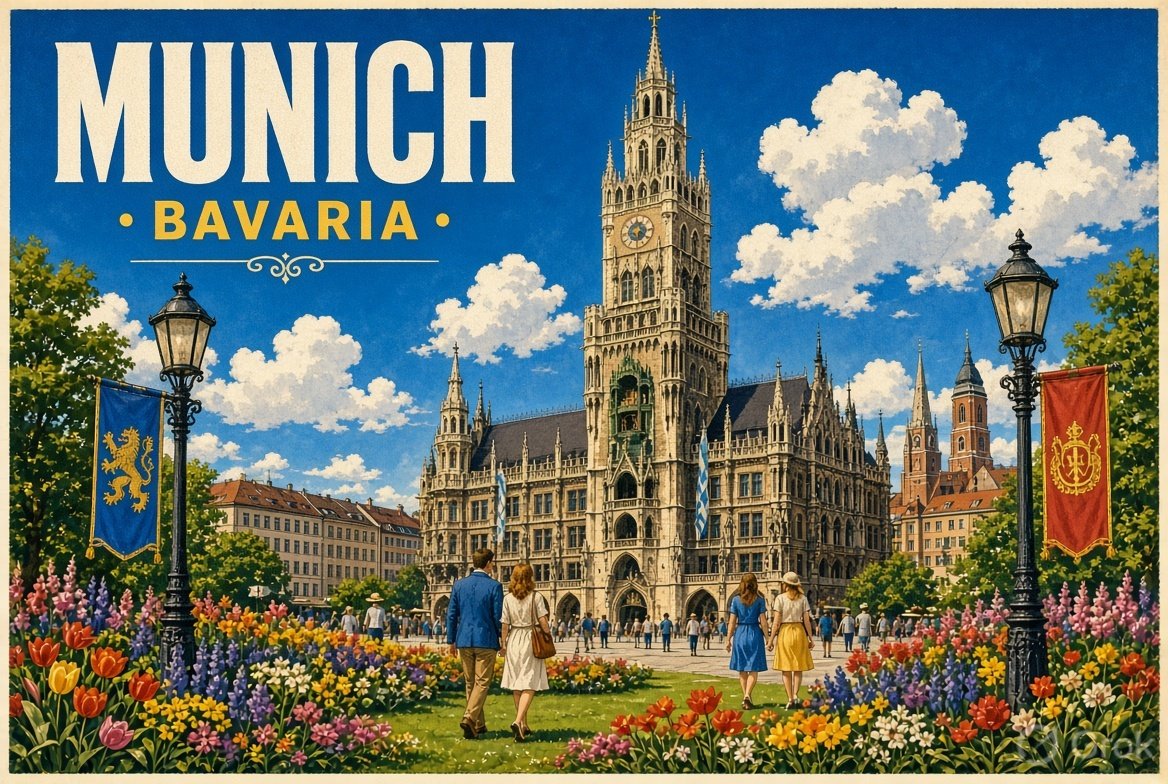
Marienplatz has been the main square of Munich since the city was founded in 1158. It takes its name from the Mariensäule, the column of the Virgin Mary put up in 1638 to celebrate the end of the Swedish occupation in the Thirty Years’ War. The north side is filled by the neo-Gothic New Town Hall, finished in 1908. In its tower the Glockenspiel, with 43 bells and 32 life size figures, plays every day at 11 am and 12 noon, and also at 5 pm from March to October: first the wedding of Duke Wilhelm V and Renata of Lorraine in 1568 with a joust, then the coopers’ dance. On the east side stands the Old Town Hall, rebuilt in late Gothic style by Jörg von Halsbach from 1470 to 1480. The Fischbrunnen fountain in front of the New Town Hall was recreated in 1954 from parts of its war damaged predecessor. Free and open all day.
Walk this order. The Mariensäule → the New Town Hall front → the Glockenspiel show → the Old Town Hall → the Fischbrunnen → 20 minutes north via Odeonsplatz to the Eisbach wave in the English Garden.
2. English Garden
From stop 1 · 20 minutes north on foot · 90 minutes–2 hours
The Englischer Garten is one of the largest city parks in the world, about 3.7 square kilometres of meadows, woods and streams. It was laid out from 1789 by Benjamin Thompson, later Count Rumford, for Elector Charles Theodore, in the informal style of an English landscape garden. At its southern edge, by the Haus der Kunst, surfers ride a standing wave on the Eisbach stream all year round. The round Greek style Monopteros temple sits on its hill with a view of the city towers. The Chinese Tower, a wooden pagoda destroyed in the Second World War and rebuilt, stands in the middle of one of Munich’s biggest beer gardens. Further north is the Kleinhesseloher See, a lake with islands, rowing boats and a beer garden of its own. Free and open all day.
Walk this order. The Eisbach surf wave → the meadows and streams → the Monopteros → the Chinese Tower beer garden → the Kleinhesseloher See → U-Bahn back to the centre and tram 17 west to Schloss Nymphenburg, about 40 minutes.
3. Nymphenburg Palace
From stop 2 · about 40 minutes by U-Bahn and tram 17 to Schloss Nymphenburg · 2–3 hours
Nymphenburg was the summer residence of the Wittelsbach rulers of Bavaria. Elector Ferdinand Maria and his wife Henriette Adelaide of Savoy began it in 1664 to celebrate the birth of their heir, Max Emanuel, and the palace grew over the following decades into a front about 632 metres wide. A long canal leads up to it. Inside, the Stone Hall has ceiling frescoes by Johann Baptist Zimmermann, and the apartments include King Ludwig I’s Gallery of Beauties and the room where King Ludwig II was born in 1845. Behind the palace a large landscape park opens up, with the cascade at the end of the central canal and small garden pavilions: the Amalienburg, a Rococo hunting lodge built by François de Cuvilliés from 1734 to 1739 with a silver and blue Hall of Mirrors, and the Pagodenburg, a tea pavilion decorated in the Chinese taste. The park is free; the palace and pavilions need tickets.
Walk this order. The palace and its canal front → the Stone Hall and the apartments → the garden cascade → the Amalienburg → the Pagodenburg → tram 17 back to the centre and on to the Residenz, about 35 minutes.
4. Munich Residenz
From stop 3 · about 35 minutes by tram and on foot to Odeonsplatz · 2 hours
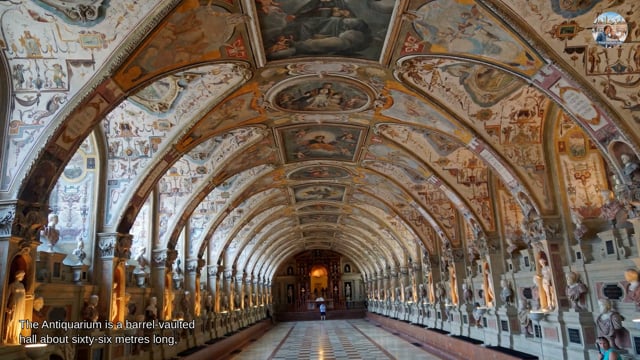
The Residenz was the city palace of the Wittelsbach dukes, electors and kings of Bavaria, and it is the largest city palace in Germany, with ten courtyards and about 130 rooms open to visitors. The bronze lions at the Residenzstrasse gates have shiny noses from passers-by rubbing them for luck. The Antiquarium, built for Duke Albrecht V from 1568 to 1571 to house his collection of ancient sculpture, is a long Renaissance hall under a painted barrel vault. The Ancestral Gallery is lined with portraits of the Wittelsbach family in gilded frames. The Cuvilliés Theatre, the Rococo court theatre built by François de Cuvilliés from 1751 to 1753, was rebuilt inside the palace after the war with its original carved boxes. North of the palace lies the Hofgarten, a formal garden with the Temple of Diana at its centre. The Hofgarten is free; the palace, treasury and theatre need tickets.
Walk this order. The Residenzstrasse front and its lions → the Antiquarium → the Ancestral Gallery → the Cuvilliés Theatre → the Hofgarten → 10 minutes south past Marienplatz to the Viktualienmarkt.


5. Viktualienmarkt
From stop 4 · 10 minutes south · 45–60 minutes
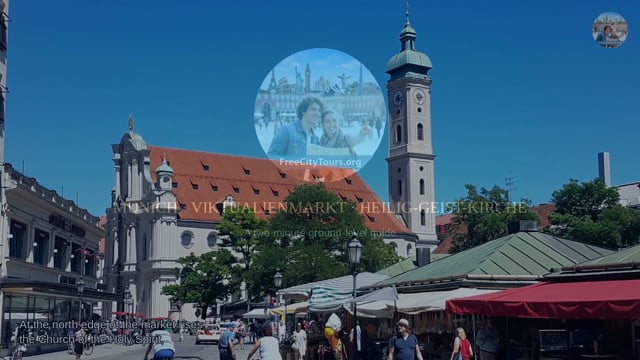
The Viktualienmarkt is Munich’s best known food market. King Maximilian I moved the city’s green market here from Marienplatz in 1807, and it has been held every day except Sundays and holidays ever since. About 140 stalls and shops sell fruit, vegetables, flowers, cheese, game, fish, spices and juices. In the middle stands a tall blue and white maypole decorated with figures of Munich’s trades, and next to it a beer garden under chestnut trees. Around the market are small fountains with statues of Munich’s folk singers and comedians, among them Karl Valentin and Liesl Karlstadt. On the north side rises the Heilig-Geist-Kirche, the Church of the Holy Spirit, a Gothic church remodelled in the Baroque style. Free to wander; closed on Sundays and public holidays.
Walk this order. The maypole → the market stalls → the beer garden → the folk singer fountains → the Heilig-Geist-Kirche → 7 minutes north west past Marienplatz to the Frauenkirche.
6. Frauenkirche
From stop 5 · 7 minutes north west · 30–45 minutes
The Frauenkirche, the Cathedral of Our Dear Lady, is the symbol of Munich. Jörg von Halsbach built the late Gothic brick church from 1468, the twin towers were finished in 1488 and it was consecrated in 1494. The towers, just over 98 metres high, only got their round domes in 1525, and no new building in the city may be taller than 99 metres. Inside it is a vast hall church, 109 metres long. By the entrance a footprint is pressed into the floor; legend says the devil stamped it here, gloating at a church that seemed to have no windows. The black marble cenotaph of Emperor Louis IV, Ludwig the Bavarian, dates from 1622. Since its renovation was completed in 2022, the south tower can be climbed or reached by lift for a view over the city to the Alps. Entry to the church is free; the tower needs a ticket.
Walk this order. The twin towers over the skyline → the west front and portal → the Gothic hall nave → the Devil’s Footprint and the cenotaph → the view from the south tower → U3 from Marienplatz to Olympiazentrum for BMW, about 15 minutes.
7. BMW Museum and BMW Welt
From stop 6 · about 15 minutes by U3 to Olympiazentrum · 2 hours
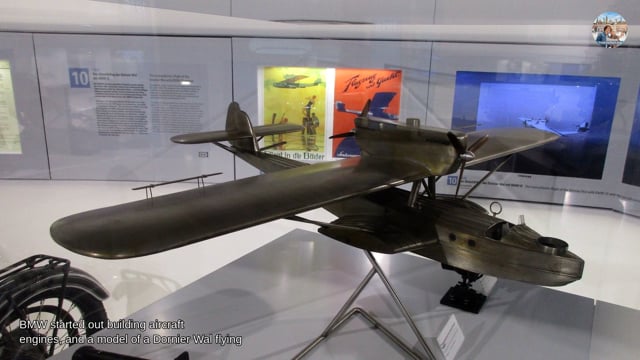
BMW’s home is in the north of Munich next to the Olympic Park. The headquarters, known as the Four-Cylinder because its tower looks like four cylinders of an engine, and the bowl shaped BMW Museum next to it were both designed by the Viennese architect Karl Schwanzer and opened in the early 1970s, around the 1972 Olympics. Across the road, BMW Welt, with its double cone and floating roof, opened in October 2007 as the showroom and delivery centre where buyers collect their new cars. The museum, reopened in 2008, tells the story of the company, which began building aircraft engines in 1916, through its motorcycles, engines, racing cars and the series of BMW Art Cars painted by famous artists. BMW Welt is free; the museum needs a ticket.
Walk this order. The Four-Cylinder tower → BMW Welt from outside → the BMW Welt hall → the motorcycles and aircraft engines in the museum → the engines and the Art Cars → U3 back to the centre and on to the Deutsches Museum on its island, about 30 minutes.
8. Deutsches Museum
From stop 7 · about 30 minutes by U-Bahn and on foot · 2–3 hours
The Deutsches Museum is one of the largest museums of science and technology in the world. It was founded in 1903 on the initiative of the engineer Oskar von Miller, and its main building stands on Museum Island in the Isar river, a former coal island given by the city for the purpose. The collections run from airships, aircraft and rockets to ships and boats in the maritime hall, a walk through a replica mine, and machines, power plants and energy. Many exhibits can be switched on or tried out. A long modernisation is under way, so some halls may be closed when you visit; check which are open before you go. The museum needs a ticket.
Walk this order. Museum Island and the main building → airships and rockets → the maritime hall → the replica mine → machines and energy → 15 minutes north over the Isar and through the Isartor to the Hofbräuhaus.
9. Hofbräuhaus
From stop 8 · 15 minutes north through the Isartor · 60 minutes, or an evening
The Hofbräuhaus am Platzl is the world’s most famous beer hall. Duke Wilhelm V founded the court brewery in 1589, and the general public was let in from 1828. When the brewery moved out to the suburbs, the building was remodelled in 1897 by Max Littmann into the beer hall you see today. The ground floor hall, the Schwemme, with its painted vaults, survived the bombing of the Second World War; the rest was rebuilt, and the Festsaal upstairs reopened in 1958. A brass band plays every day, beer comes in one litre stone or glass steins, and regulars keep their own steins locked in racks in the hall. Behind the building is a courtyard beer garden under chestnut trees. Free entry; you pay for what you eat and drink.
Walk this order. Platzl square → the facade and arcades → the Schwemme and the Festsaal → steins and the brass band → the courtyard beer garden → U3 from Marienplatz to Olympiazentrum for the Olympic Park, about 20 minutes.
10. Olympiapark
From stop 9 · about 20 minutes by U3 to Olympiazentrum · 2–3 hours
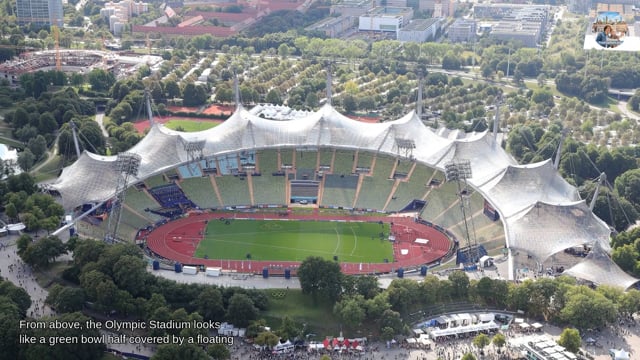
The Olympiapark was built for the 1972 Summer Olympics on the Oberwiesenfeld, a former airfield in the north of the city. The architects Behnisch and Partners planned the park, and the famous tent roofs of steel cable and acrylic glass over the stadium, the hall and the swimming hall were designed by Frei Otto with Günter Behnisch. The Olympic Stadium was the home ground of FC Bayern Munich and TSV 1860 Munich until 2005 and is now used for concerts and events. The Olympic Tower, 291 metres high, has a viewing platform at about 190 metres and a revolving restaurant. The Olympiaberg hill was piled up from the rubble of the Second World War, and the Olympic Lake lies at its foot. The park is free; the tower, stadium tours and roof climbs need tickets.
Walk this order. The Olympic Stadium → the Olympic Tower → the Olympic Lake → up the Olympiaberg → the Olympic Hall and the tent roofs → end of the tour; U3 takes you back to Marienplatz in about 15 minutes.